
August Sander
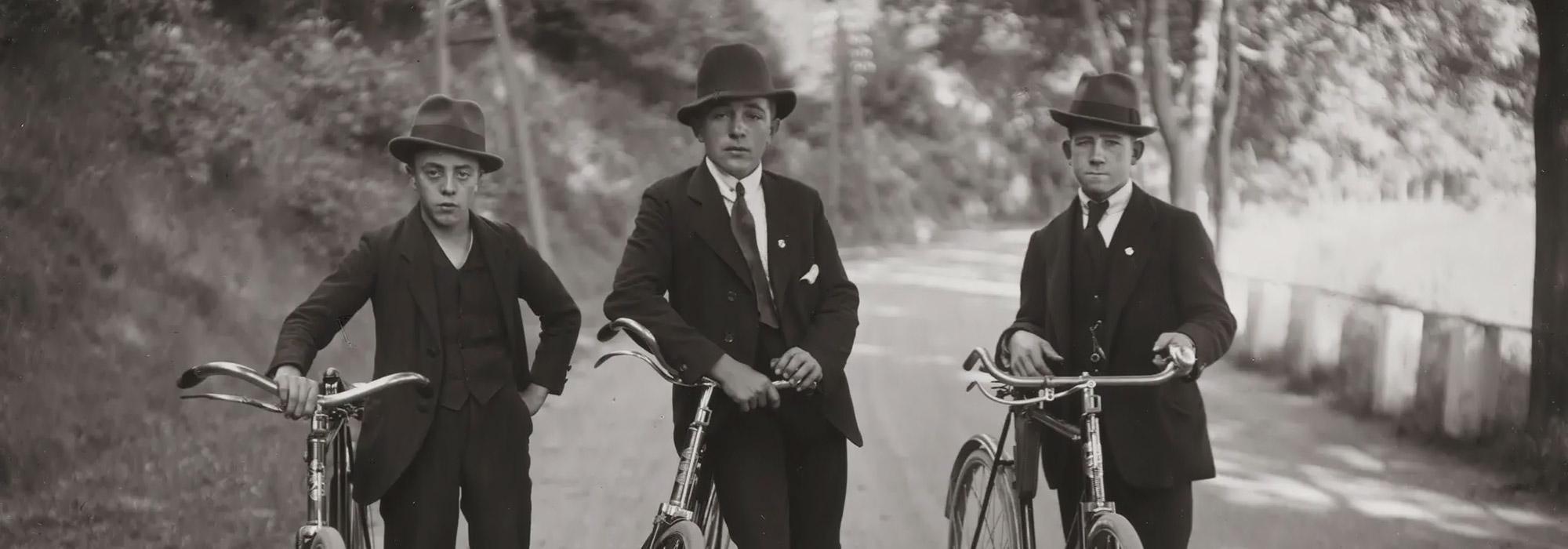
August Sander, born November 17, 1876 in Herdorf (Germany) and died April 20, 1964 in Cologne (Germany), is a German photographer. Meticulous portrait painter of the Weimar Republic, August Sander brings together documentary photography and artistic practice, an approach never seen before.
Life
Son of a miner, August Sander worked, as soon as he finished compulsory school, as a dumpster boy in the mining installations of Herdorf. It was as an assistant to a photographer who worked for the mine that he came into contact with photography.
His military service (1897-1899) was another step on the road to his professionalization. In Trier (Germany), as an assistant to a photographer, he continues to progress. With his recommendations, he traveled for two years, and this led him, among others, to Berlin, Magdeburg, Halle, Saale, Leipzig and Dresden.
In 1901, he worked for a photo studio in Linz (Austria). In 1902, he became co-owner and, in 1904, owner. In 1910, he left his business in Linz (Austria) and settled in Cologne (Germany), where he founded a new studio.
During the First World War, he served in the Landsturm (military formation made up of reservists).
In the early 1920s, August Sander was in contact with progressive artists from Cologne. He spoke closely with the artists Franz Wilhelm Seiwert, Heinrich Hoerle, Gerd Arntz, Gottfried Brockmann, Otto Freundlich, Raoul Hausmann and Stanislaw Kubicki, Hans Schmitz, Augustin Tschinkel and Peter Alma. In addition, Sander is close to the painters Jankel Adler, Otto Dix, Heinrich Pilger and Anton Räderscheidt. He is also in contact with musicians, writers, architects and actors, many of whom have their portraits produced by Sander and are found in his work Menschen des 20. Jahrhunderts (Men of the 20th century).
In 1929, he published a first book Antlitz der Zeit (The Face of that time), a choice of 60 portraits of Menschen des 20. Jahrhunderts (Men of the 20th century).
Nazism strongly affects his work and his personal life. His son Erich was arrested in 1934 and sentenced to prison where he died in 1943 or 1944, shortly before the end of his sentence. In 1936, his book Antlitz der Zeit (The Face of that time) was seized and the printed copies destroyed.
During the war, he moved his Lebensmittelpunkt (official place of accommodation for food rationing) to Kuchhausen in the Westerwald, where he could secure most of his negatives and photographs before the bombing. His studio was destroyed in 1944. In 1946, August Sander began a large series of images on the destruction of the war in Cologne.
August Sander died on April 20, 1964 in Cologne. His grave is in the Melaten-Friedhof, the main cemetery in Cologne.
Work
August Sander described photography with three words:
See, observe, think
August Sander
August Sander’s work comes at a time when the Weimar Republic is beset by deep divisions: social, political and ideological. But also in a general movement of transformation of photography in Europe and in North America, which questions the object of photography, the relation to the people photographed as well as the marketing. It is in this context that August Sander works on people. Menschen des 20. Jahrhunderts (Men of the 20th century) is a political enterprise because the project responds to the challenges of representing Germany and because August Sander has been involved in the debates relating to this situation.
Insofar as I draw up, through an absolute photograph, an observation of the different social strata as well as of their environment, I hope to make in its truth the psychology of our time and of our people.
August Sander
He chooses the portrait, individual or group, where the camera is generally at chest height, or a little lower, and where the character(s) are grasped head-on.
To see
Quite personal selection and absolutely not exhaustive, obviously.
Peasant de Westerwald
1913Peasant girls
1925Worker
1929Disabled miner
1927-28