
Lightmeters
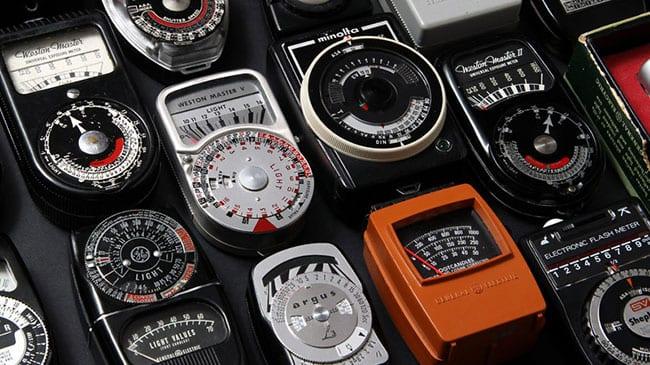
For a long time the essential accessory, the lightmeter has become less and less used over the years. But what about today, in 2016.
Update 2020: Originally written in 2016, this article was updated in April 2020.
Schematically, a lightmeter measures an amount of light (either incident or reflected) and transforms this measurement into shooting parameters. Today we will be dealing with external exposure meters, although you will see this at the end of the article.
A bit of history
It was at the end of the 19th century with the progress of electrical engineering that the first solutions for automatic light measurement were born. It was in 1883 that the American Charles Fritts developed the first functional selenium cell (Fritts, C. E. (1883). "On a New Form of Selenium Photocell". American Journal of Science.). The principle is, thanks to a selenium layer mounted on a plate, to transform light (id. Light energy) into electric current. If the Fritts process works, he suffers from a handicap making it unfit for practical operation, the quantity of electricity produced is weak and the amplifier necessary to detect it does not allow it to be carried in a portable device.
It was not until the beginning of the 20th century and in particular the developments of the First World War to see the appearance of a new process: the Gripenberg cell.
It was fifteen years later that the first "light meter" or "photometer" manufactured and sold by J. Thomas Rhamstine of Detroit. In 1931 an advertisement promotes it in the magazine Home Movies. Around the same time another device, the Alnico manufactured by the Japanese Tokushichi Mishima uses another technology which does not require batteries. Another pioneer in the measurement of light for cinema or photography, the Gossen Ombrux (of German origin) and the Weston 617. It is moreover the latter which is considered to be the first exposure meter for photographer, in addition to light measurement, the device is equipped with slide rule.
From portable objects, the exposure meters or cells, have become integrated into our cameras. Automatic exposure metering is the work of internal camera exposure meters. However, measurement with an external cell may still be necessary on highly contrasted scenes, for example.
Market brands
Today the traditional light meters market is broadly divided between two major players:
There are other brands like: Kenko, KKMoon, ou Hanimex.
The price ranges are extremely wide, most high-end models also being flashmeters, ie devices capable of measuring the light of a flash.
Modern solutions
Since 2010, the situation changed significantly, the cells are all integrated into our cameras and therefore into our smartphones. Indeed to correctly expose the photos, mobile phones embed a light measurement system, resulting in applications, mostly free which transforms your smartphone into a portable cell. Ideal for using old cameras and old lenses.
When I work in film I use either my portable cell, a Gossen F2, or one of two applications on Android:
The difference between the Gossen and my phone, clearly the price! But not only, fortunately. The Gossen F2 also allows me to measure the light of my flashes and therefore to work with ambient light and one or more flashes precisely. But for a measurement of ambient light, the "smartphone" solution is fully functional.
More about lightmeters
Lightmeters
Apps
LightMeter - 3,99 €
Light meter for photography - Free with announces
Light Meter - Free - Free with announces
Light Meter - Free with announces
Illuminomètre parlant - Free with announces