
The SX-70 turns 45
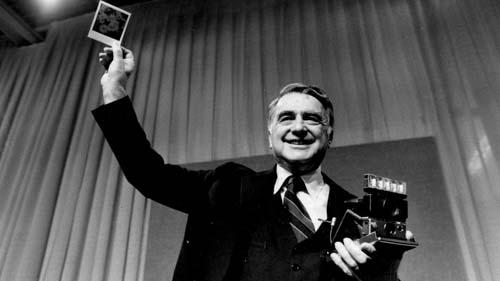
No, no — 2017 isn't only about Emmanuel Macron taking office; it's also the 45th anniversary of a revolution called the SX-70.
It was on 7 May 1909 — nothing to do with our new president — that the American Edwin H. Land was born in Bridgeport (Connecticut). If the name doesn't ring a bell, he is the founder of Polaroid and the inventor of a revolutionary process, the SX-70.
Edwin H. Land
Edwin Land's industrial career began between the two wars, in 1932. He founded Poland Corp. to commercialise the applications of one of his inventions, a polarising film. In 1937, Poland Corp. became Polaroid. In 1947, the American engineer presented an instant camera to the Optical Society of America. The process used could develop a positive image in less than a minute. Commercial success came right away. In 1963, Polaroid released a colour process. The SX-70 process would have to wait until 1972.
That year, Life magazine's cover headline read: "A genius and his magical camera," about Edwin H. Land and the SX-70.
Edwin H. Land passed away on 1 March 1991 in Cambridge (Massachusetts).
SX-70 process
The SX-70 process made possible an eponymous camera. SX-70 cameras are lighter, and the chemistry used enables instant development in broad daylight, inside a sealed envelope that contains all the residual products of the process. SX-70 films — ancestors of the 600s — have a square sensitive surface 7.9 cm on each side and a nominal sensitivity of 150 ASA.
The SX-70 camera was produced from 1972 to 1981 in various models. After Polaroid abandoned film processes, Impossible took over the manufacture and sale of SX-70-format film.