
Presidential photo: Emmanuel Macron
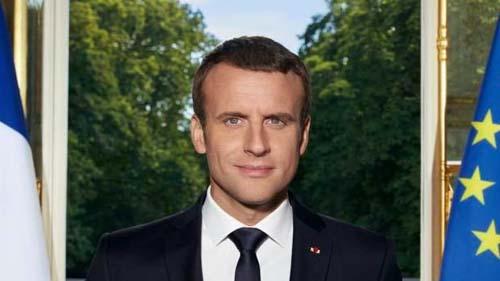
After every inauguration, in France or elsewhere, it is tradition to portray — to immortalise — the new president, in paint or in photo.
Today the arrival of the presidential photo is more and more media-driven, so much so that journalists are even caught off guard by press officers orchestrating the "leaks" — such as Sibeth Ndiaye, who shared the following video on Twitter:
#AvecLePrésident for his official portrait. @soazigdlm pic.twitter.com/TSFXhEWLEy
— Sibeth Ndiaye (@SibNdiaye) 29 June 2017
Journalists "decoded" at length the five or six symbols placed in the image. Let's not go over that — you won't have any trouble finding such an article. Let's instead look at how this photo was made, by poring over the EXIF data.
EXIF of the presidential photo
The photo was taken by Soazig de la Moissonnière and a few assistants, if Sibeth Ndiaye's making-of is to be believed. No flash apparently, but continuous lighting. On the gear side, a Canon EOS 5D Mark IV and a 24-70 f/2.8L were used to take the photo. As for settings, the focal length is 61 mm at f/10 with an ISO of 800. Shutter speed is 1/200 second. Finally, the image was retouched with Adobe Photoshop CC 2017 on Macintosh. On the retouching side, I believe the portrait was cut out to accentuate the background blur. At f/10, the background looks a little too blurred to me — the depth of field is about 2 metres given the shooting parameters.
Other presidential photos
For comparison, Donald Trump's official photo was taken with a Canon 1Ds Mark III and a 70-200 f/2.8 IS, while Barack Obama's second portrait, taken by Pete Souza, was made with a Canon 5D Mark III and the magnificent 85 mm f/1.2L. For François Hollande, Raymond Depardon used a Rolleiflex. He said at the time:
I tried first with a Leica, then a digital camera, and finally with my old 1962 Rolleiflex, which often brings me luck. And it's the photo I got with that one, in 6×6 format, that turned out to be the right one.