
Why you should buy an Impossible I-1
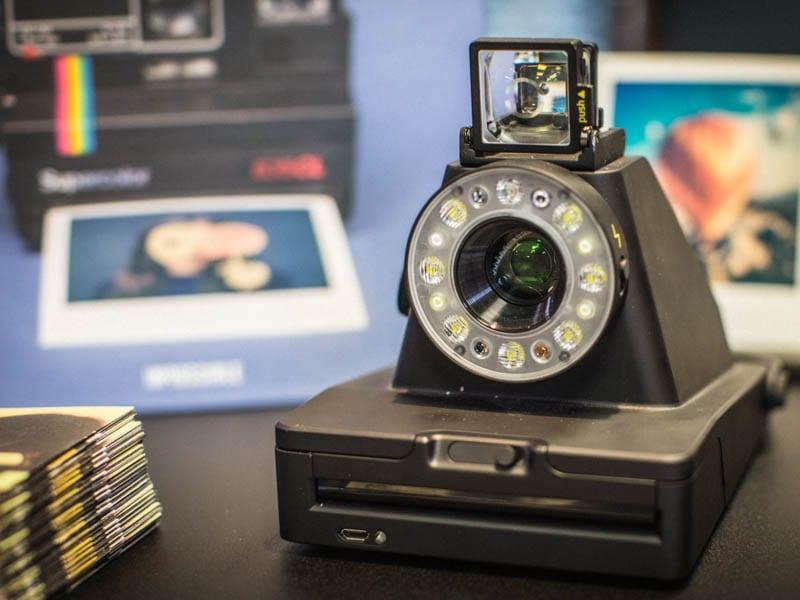
The I-1 is The Impossible's new camera — yet another camera? No: a camera you really should buy!
Disclaimer: First, let's be clear that this article reflects only our own view; it isn't a sponsored piece for The Impossible, but our independent appraisal.
As we mentioned in a previous article, Impossible has put a new camera on sale: the . On 29 October 2016, in Lyon, at a presentation of the by Julien, we had the chance to handle the beast. Convinced of the case for buying an I-1, getting hands-on with the camera and admiring its superb build motivated this article. So let's get to the point and answer this question: why should you buy one?
The I-1: for whom?
Who's the I-1 for? Pretty much everyone:
- Lovers of images with character
- Anyone disappointed by all-digital
- The "cloud"-impaired
- Fans of keepsake photos
- Born storytellers
- Etc.
In short, the is a versatile camera. It lets you capture on paper, in colour or in black & white, images with a "real soul" — a real creative character. No more flat phone images that you "have" to layer all kinds of filters onto. No, with the , photos have character at the moment of capture. And if you want to share them on your favourite social networks, it's simple: just take a photo of the printed shot! It's just a different way of doing things — instead of printing photos from your phone (which, ultimately, you rarely do), you photograph your prints.
The isn't a camera for hipsters or Parisian bobos; it's a camera to reconcile you with "social" photography — the kind that immortalises the moments of our lives and makes them shareable.
The I-1: how?
How does the work? Very simply — no endless settings; the camera has an autofocus that engages simply by half-pressing the shutter. On the light side, the body has a ring flash made of LEDs. The LEDs also indicate battery level and the number of shots left in the film pack.
Unlike Polaroid bodies, the body isn't powered by the film pack but by an internal battery. It recharges simply by plugging the camera in via the front mini-USB port. Battery life is roughly 100 photos on a full charge — more than enough for most projects: parties, events, or art projects.
The also has a removable viewfinder and a flash on/off button. To sum up:
- An on/off button
- The shutter release, which also handles focus
- A button to enable the flash
- The ring flash, used to light the subject and to indicate battery charge and shots remaining
Lastly, the also has a tripod thread for mounting it on, say, a tripod. A Bluetooth connection lets you control the camera remotely. A simple-to-use camera, yet well built, with a clean design and a wide range of films available.
The I-1: what for?
Now that we've seen the camera is both simple and versatile, that it lets you take photos and share them, why buy one — or give one as a gift?
Simply because, in an age of frenzied consumption of images that sit dormant in phone memories, computers or clouds (Google Drive, OneDrive, Dropbox, etc.) — useless images, basically — the lets you make useful (and pretty) photos. Impossible films let you choose between , , or special editions (red & black or yellow & black, for example).
And if the doesn't seem right for you, it's a gift idea to keep in mind for Christmas!
Instant photography
- Dimensions: 145 mm (L) × 110 mm (W) × 99 mm (H) (with viewfinder, H = 108 mm)
- Weight: 440 g (without film pack)
- Operating temperature: 4 to 38°C, 5 to 90% relative humidity
- Bluetooth: Bluetooth Low Energy 4.0
- Compatible films: Impossible Type 600 and Type I, in colour or black & white, including special editions.
- Battery: high-performance 500mAh lithium-ion battery (35C discharge rate)
Materials:
- Outer shells: Polycarbonate + ABS with soft-touch rubberised coating
- Viewfinder, viewfinder mounting plate, strap mounting plates: zinc-aluminium alloy
- Lenses: optical-grade polycarbonate and acrylic lenses, anti-reflective coated
- Shutter: Custom-built, with precision stepper motors driving shutter and focus
Optical system:
- Lenses: 6 lenses in total, allowing 5 possible configurations
- Autofocus: 5-zone autofocus system, based on distance measurement via reflected infrared light
- Macro (0.23 – 0.47 m)
- Close-up (0.47 – 1 m)
- Medium close-up (1.0 – 2.2 m)
- Medium shot (2.2 – 4.5 m)
- Wide shot (4.5 – ∞ m)
- Focal length: 82 – 109 mm
- Angle of view: 41 degrees vertical, 40 degrees horizontal
Flash:
- Advanced 12-LED ring flash, comprising 8 focused LEDs for greater reach + 4 diffused LEDs for softer light at close range (portraits).