
Visa pour l'Image, a photo pulled in Deauville, Sal Veder gone: the week the image had to defend itself
« Perpignan opens its 38th edition in defence of the real, a Normandy festival takes down a Gaza photograph so as not to upset anyone, London muddies the right to photograph in public, and the author of "Burst of Joy" dies at 99. On the gear side, Ricoh readies a 40 mm GR IVx and OM System takes back control of its future. »
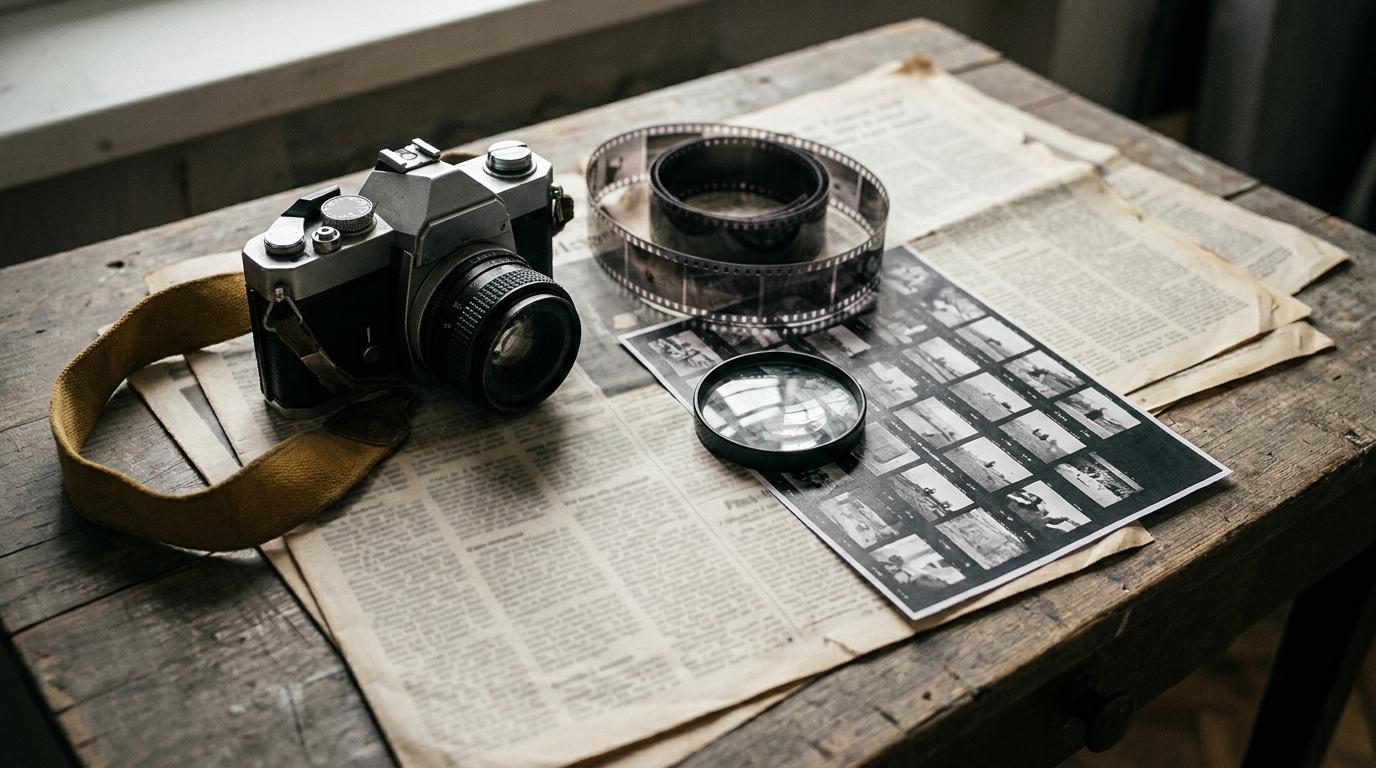
A week in which photography talked less about cameras than about the right to look. Perpignan opened its doors, a Normandy festival took down an image that made people uncomfortable, London told asylum seekers you do not photograph in the street, and the man who summed up a homecoming from war in a single frame died. The gear followed, more quietly.
Visa pour l'Image, 38th edition: the real strikes back
Perpignan opened the 38th edition of Visa pour l'Image on Saturday 29 August, running to 13 September: twenty-seven free exhibitions, six screening evenings at the Campo Santo, more than €160,000 in prizes.
The prize list says plenty about where the festival is looking. The ICRC Humanitarian Visa d'or goes to Khames Alrefi for "Civilians: the first victims", made in Gaza on hunger, bombardment and displacement. The Ville de Perpignan Rémi Ochlik Visa d'or goes to Philémon Barbier, working for Le Monde and Le Figaro, on Syria after Assad. The Digital Information Visa d'or rewards a New York Times team, and the Écologie 360 Prize honours Laurent Ballesta's Antarctic dives.
On the walls: Raymond Depardon, showing at the festival for the first time; Gerd Ludwig and thirty-three years spent around Chernobyl; Tyler Hicks in Kostiantynivka; Marion Péhée with adolescents displaced by war; David Guttenfelder on ICE operations in Minneapolis.
Jean-François Leroy framed the edition around verification, with deepfakes squarely in view, and turns the usual argument around: AI needs reliable data, which means newsrooms that go and see for themselves. In the year of photography's bicentenary, it is a way of recalling that the job is not to produce images but, first of all, to answer for them.
Deauville pulls a Gaza photograph "so as not to offend anyone"
At the Sport Images festival in Deauville, a photograph by Palestinian Associated Press photographer Jehad Alshrafi was taken down and replaced with a picture of cyclists (as reported by PetaPixel). Taken on 14 February 2026, it showed footballers playing on a makeshift pitch in Gaza, between gutted buildings. It was one of three hundred prints on show.
Organisers justified the removal, which followed outside requests, with a sentence that will stick: "We don't want to get into a controversy, nor offend anyone." Local councillor Sylvain Larcher pointed out that the image went beyond sport — it spoke of the will to keep playing, to gather, to live, when everything around has been destroyed.
Two days apart, two French festivals answered the same question in opposite ways. That is a fair definition of the moment we are in: showing is still an act, and a hang is already a position.
UK: an official booklet muddies the right to photograph
The Home Office published a nine-page booklet, "Understanding behaviours and expectations in the UK", aimed at asylum seekers. It states that in the UK "you should not take pictures or video of someone without their permission", including in streets and parks, on pain of arrest (the full story).
The National Union of Journalists called the text inaccurate: photographing people in public is not unlawful in Britain. By conflating ordinary photography with non-consensual sexual imagery — which is very much a crime — the booklet manufactures a confusion photojournalists will pay for: more hostility, unwarranted stops, harder ground to work.
It looks like a distant problem when you work in France. It is not: the right to photograph in public is defended above all by how well it is understood — by those who exercise it, and by those watching them do it.
Sal Veder (1926-2026), who made "Burst of Joy"
Slava "Sal" Veder died on 27 August, aged 99. He joined the Associated Press in 1961 at the Sacramento bureau, moved to San Francisco, and retired in 1993.
On 17 March 1973, at Travis Air Force Base in California, he photographed the return of Colonel Robert L. Stirm, held five years as a POW in North Vietnam: his daughter Lorrie, arms open, running towards him, the family behind. "Burst of Joy" won him the 1974 Pulitzer Prize. Veder explained the picture's power through one detail: Stirm has his back to the camera, so he is nobody in particular — he is everyone else.
The rest belongs to the trade's folklore: that day, surrounded by dozens of colleagues, he developed his film in a women's bathroom turned darkroom, to be first on the wire. Talent, often, is that too.
Gear: a 40 mm GR, and OM System buying itself back
On 26 August Ricoh announced the development of the GR IVx: the same platform as the GR IV released in September 2025, but a new 26.1 mm f/2.8 lens — around 40 mm in 35 mm terms — with eight elements in six groups, three of them aspherical. Add five-axis sensor-shift stabilisation, against three on the GR IIIx, and 4K 30/24p video, a first for the series. Release announced for winter 2026, still without weather sealing.
At OM System the news is not a camera but a shareholding: the management team led by Shigemi Sugimoto now holds 100 % of the shares, having bought out Japan Industrial Partners in April 2026 — the fund that had run the brand since Olympus sold its imaging business in 2021. Sugimoto promises faster decisions on long-term investment and speaks explicitly of "new sensors and engines". The financial report released days later shows sales on a plateau: the room to manoeuvre is narrow. A new PEN is announced for 9 September.
In brief: 7Artisans pushes an autofocus 10 mm f/2.5 full-frame fisheye (Sony E, Nikon Z, L-mount) and a 109-gram 18 mm f/2 for APS-C; Panasonic refreshes four lenses, three of them Micro Four Thirds; Sigma has set an announcement for 8 September, headlined by an 85 mm f/1.2 DG Art; Adobe brings Camera Raw's non-destructive exposure controls into Photoshop itself. And Miller, the Australian tripod and fluid-head maker, is closing after nearly eighty years.
What I take away from the week
Two festivals, two answers. An administrative booklet that, in nine pages, weakens a right nobody had thought to contest. A photographer of 99 who leaves behind an image still remembered fifty-three years on. And, in the background, bodies and lenses that keep getting better — which is fine, but that is not where the week was decided. Gear can be bought; the right to look has to be defended.