
Walker Evans
« Walker Evans, born November 3, 1903 in Saint-Louis, United States and died April 10, 1975, in New Haven, Connecticut, was an American documentary photographer. »
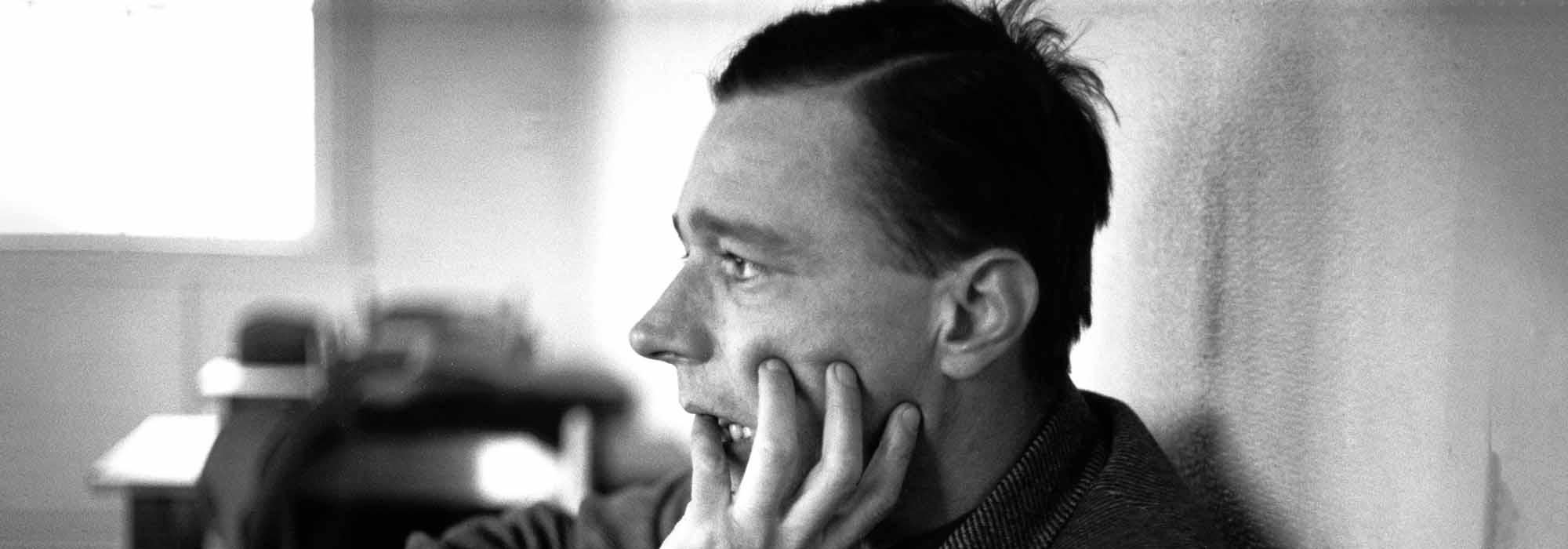
Walker Evans, born November 3, 1903 in Saint-Louis, United States and died April 10, 1975, in New Haven, Connecticut, was an American documentary photographer.
Walker Evans' life
The young Walker Evans begins his life in Missouri then in Illinois and Ohio, at the rate of the transfers of his father. At 16, he left home to go to a boarding school in Connecticut before joining his mother and sister in New York. Aged 23, he travels to Europe. He studied for a few months in Paris before going to the south of France and then to Italy.
He began photography in 1930. Back from France, he settled in the Brooklyn district of New York. Photographer Berenice Abbott introduced him to the work of the French photographer Eugène Atget. He's mainly known for his documentary photographs of Paris at the end of the 19th and the beginning of the 20th century.
In 1933, some forty Walker Evans photos were exhibited at the Museum of Modern Art (MoMa) in New York. The same year he was sent to Cuba to document the dictatorship of Gerardo Machado for Carleton Beals' book The Crime of Cuba (1933). There, Evans photographed those affected by the oppressive regime. It was in Cuba that Evans developed his signature humanist aesthetic. Still in Cuba, he became friends with the American writer Ernest Hemingway. As Evans later recalled, "I had a wonderful time with Hemingway, drinking every night. He was idle…and he needed a drinking buddy, and I filled the role for two weeks."
The following year, in 1934, he began to collaborate with Fortune magazine. From 1935 he produced reports for the American Department of Agriculture, then for the Farm Security Administration. This agency organizes aid for farmers affected by the Great Depression. Walker Evans travels to Pennsylvania, New Orleans, Alabama, Mississippi, Georgia and West Virginia.
Cotton sharecroppers Frank Tengle, Bud Fields, and Floyd Burroughs in Hale County, Alabama - Walker Evans, 1936 for Let Us Now Praise Famous Men
In 1938, the MoMa organized the first major monographic exhibition devoted to him: Walker Evans, American Photographs. Walker Evans was awarded a John-Simon-Guggenheim Foundation grant three times in 1940, 1941 and 1959.
En 1941, avec l'écrivain James Agee, il co-signe Let Us Now Praise Famous Men, un reportage sur la pauvreté en Alabama. Entre 1943 et 1945 il collabore avec le Time, puis à partir de 1945, il devient le premier photographe salarié à plein temps de Fortune.
In 1941, with the writer James Agee, he co-signed Let Us Now Praise Famous Men, a report on poverty in Alabama. Between 1943 and 1945 he collaborated with Time Magazine, then from 1945, he became Fortune's first full-time salaried photographer.
Walker Evans' artwork
Walker Evans is one of the most influential American photographers of the 20th century. His shots of America during the Great Depression, his documentary style and his fascination with American popular culture marked and still mark many photographers and artists.
One of her best-known photos is certainly the portrait of Allie Mae Burroughs, photographed in 1936. Like the portrait of Florence Owens Thompson, Migrant Mother produced by Dorothea Lange the same year, this photo is a summary of the Great Depression. A simple, hard and subtle portrait.
Allie Mae Burroughs, 1936 - Walker Evans
The American Library of Congress is a gold mine for discovering the work of Walker Evans, it allows you to understand his style. We discover or rediscover a documentary approach, still modern today.
New York, New York. 61st Street between 1st and 3rd Avenues. Children playing in the street, 1938 - Walker EvansNew York, New York. 61st Street between 1st and 3d Avenues, 1938 - Walker Evans
Walker Evans' favorite subjects are Americans and, through them, American society.
Independence Day, Terra Alta, West Virginia, 1935 - Walker EvansCarpenter, Westmoreland County, Pennsylvania, 1935 - Walker EvansLegionnaire, Bethlehem, Pennsylvania, 1935 - Walker Evans
Walker Evans also gives us shots of buildings that are part of the culture of American society.
Untitled, Beaufort, South Carolina, 1936 - Walker EvansPosters covering a building near Lynchburg to advertise a Downie Bros. circus, 1936 - Walker EvansNegro barber shop. Atlanta, Georgia, 1936 - Walker Evans
At the end of his life, Walker Evans used a Polaroid SX-70 to continue his work of immortalizing America. If the medium changes, the framing remains the same, alternating portraits and graphic representations of American society.
To read
If you don't see the covers of the books we propose, turn off your ad blocker.